Evaluating Cactus Succulent Watercolor Clipart PNG for Creative Projects
In the realm of digital design, selecting the right visual assets is a critical step that influences the final quality of any project. For designers, hobbyists, and small business owners looking to incorporate botanical themes, Cactus Succulent Watercolor Clipart PNG represents a specific category of digital resources worth evaluating. These assets combine the organic, soft aesthetic of watercolor painting with the technical utility of high-resolution portable network graphics. Understanding the characteristics, applications, and limitations of this file type is essential for determining whether it aligns with your specific creative goals.
Defining the Asset: Aesthetic and Technical Specifications
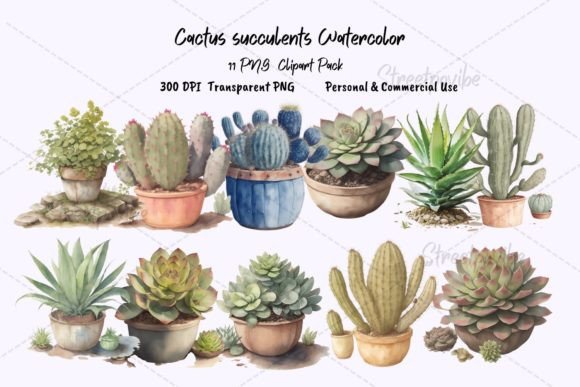
At its core, this collection consists of digital illustrations depicting various cacti and succulents rendered in a watercolor style. Unlike vector graphics or flat digital illustrations, watercolor clipart mimics the texture, blending, and transparency of traditional paint on paper. This provides a handcrafted, artistic feel that is often difficult to replicate with standard digital tools.
From a technical standpoint, the value of these assets lies in their file specifications. The bundle typically includes PNG images with transparent backgrounds, sized at 2000 x 2000 pixels with a resolution of 300 DPI (dots per inch). This combination is significant for several reasons. The transparent background allows the image to be layered over any color or texture without a white box surrounding the plant, ensuring seamless integration into diverse layouts. The 2000-pixel dimension offers substantial flexibility, while the 300 DPI rating indicates print-ready quality, distinguishing these files from low-resolution web graphics that may appear pixelated when enlarged.
Primary Applications and Use Cases
The versatility of high-resolution watercolor clipart makes it suitable for a wide array of mediums. One of the most common applications is in print-on-demand products. Because the files are 300 DPI, they are technically capable of producing sharp results on physical items such as t-shirts, mugs, and phone cases. The organic nature of the watercolor style pairs particularly well with lifestyle brands, eco-friendly products, and bohemian-themed merchandise.
Beyond physical goods, these designs serve as effective decorative elements for websites and digital interfaces. While web graphics often require lower resolutions to save loading time, starting with a high-quality source file allows designers to scale down without losing clarity. Furthermore, the aesthetic is highly popular in the realm of digital journaling and planning. Users of tablets and styluses often seek assets that mimic traditional media to enhance their digital planners, stickers, and habit trackers. The "sticker" look, achieved through the transparent PNG format, is ideal for these interactive digital environments.
Benefits of Choosing Watercolor PNGs
There are distinct advantages to selecting this specific type of clipart over other formats. The primary benefit is the balance between artistic quality and ease of use. Creating authentic watercolor textures from scratch requires significant skill in both traditional painting and digital scanning or complex software manipulation. By utilizing a pre-made bundle, creators can bypass the time-consuming creation process while still achieving a professional, hand-painted look.
Additionally, the scalability provided by the 2000 x 2000 px size is a major asset. Designers can use the full image for large banners or crop specific sections to create small icons, social media avatars, or pattern repeats. This adaptability means a single bundle can support multiple facets of a branding project, from a website header to a business card logo, ensuring visual consistency across different scales.
Considerations and Potential Tradeoffs
While the benefits are clear, potential users must also consider the tradeoffs inherent in using raster-based PNG files compared to vector formats. The most notable limitation is scalability limits. Although 2000 pixels is generous, it is not infinite. If a project requires printing on a very large format, such as a billboard or a large wall mural, a PNG may lose sharpness if stretched beyond its intended resolution. In such scenarios, vector files (SVG or EPS) would be a superior choice as they can be scaled indefinitely without quality loss.
Another consideration is editability. Once a watercolor image is saved as a flattened PNG, the individual brushstrokes and color layers are merged. This means you cannot easily change the color of a specific leaf or adjust the opacity of a shadow without affecting the whole image. If a project requires extensive color customization to match specific brand guidelines strictly, a vector file or a layered PSD file might offer more control.
Decision-Making Insights: Is This Bundle Right for You?
Determining whether to invest in this Cactus Succulent Watercolor Clipart PNG bundle depends largely on the scope and nature of your project.
This asset is a strong fit if:
- You are creating products for print-on-demand services where 300 DPI is the standard requirement.
- Your design aesthetic leans towards natural, soft, or artistic themes rather than corporate or geometric styles.
- You need ready-to-use elements for digital planning, sticker creation, or social media content.
- You lack the time or skills to create custom watercolor illustrations but require that specific look.
Alternatives may be worth considering if:
- Your project involves large-scale signage or architectural graphics where infinite scalability is necessary.
- You require precise color matching that necessitates editing individual components of the illustration.
- You are working strictly within a vector-based workflow (e.g., Adobe Illustrator) and prefer editable paths over raster pixels.
Final Evaluation
In conclusion, the Cactus Succulent Watercolor Clipart PNG bundle offers a robust solution for creators seeking high-quality, botanical-themed visuals. The combination of 300 DPI resolution and transparent backgrounds bridges the gap between digital convenience and traditional artistry. While it may not replace vector graphics for every single use case, particularly those requiring massive scaling or deep layer editing, it excels in applications ranging from apparel design to digital stationery. By carefully weighing the need for artistic texture against the requirements for editability and scale, users can make an informed decision on whether these designs will effectively elevate their next project.